
Spanish Past Tenses Explained Simply: A Beginner-Friendly Guide
One of the biggest challenges for Spanish learners is knowing which past tense to use. Unlike English, Spanish has several ways to talk about the past, and each one tells a slightly different story.
Should you say fui or iba? Is it he comido or comí? When do Colombians use one instead of another?
The good news is that once you understand the purpose of each tense—not just the grammar—it becomes much easier.
In this guide, you'll learn the four most common Spanish past tenses with simple explanations, real-life examples, and tips to sound more natural when speaking Spanish in Colombia.
Why Does Spanish Have So Many Past Tenses?
Think of Spanish past tenses like different camera angles.
📸 Preterite → A photo of a completed event.
🎥 Imperfect → A video showing what was happening.
✅ Present Perfect → Something connected to the present.
📖 Past Perfect → Something that happened before another past event.
Once you think about the speaker's perspective, choosing the correct tense becomes much easier.
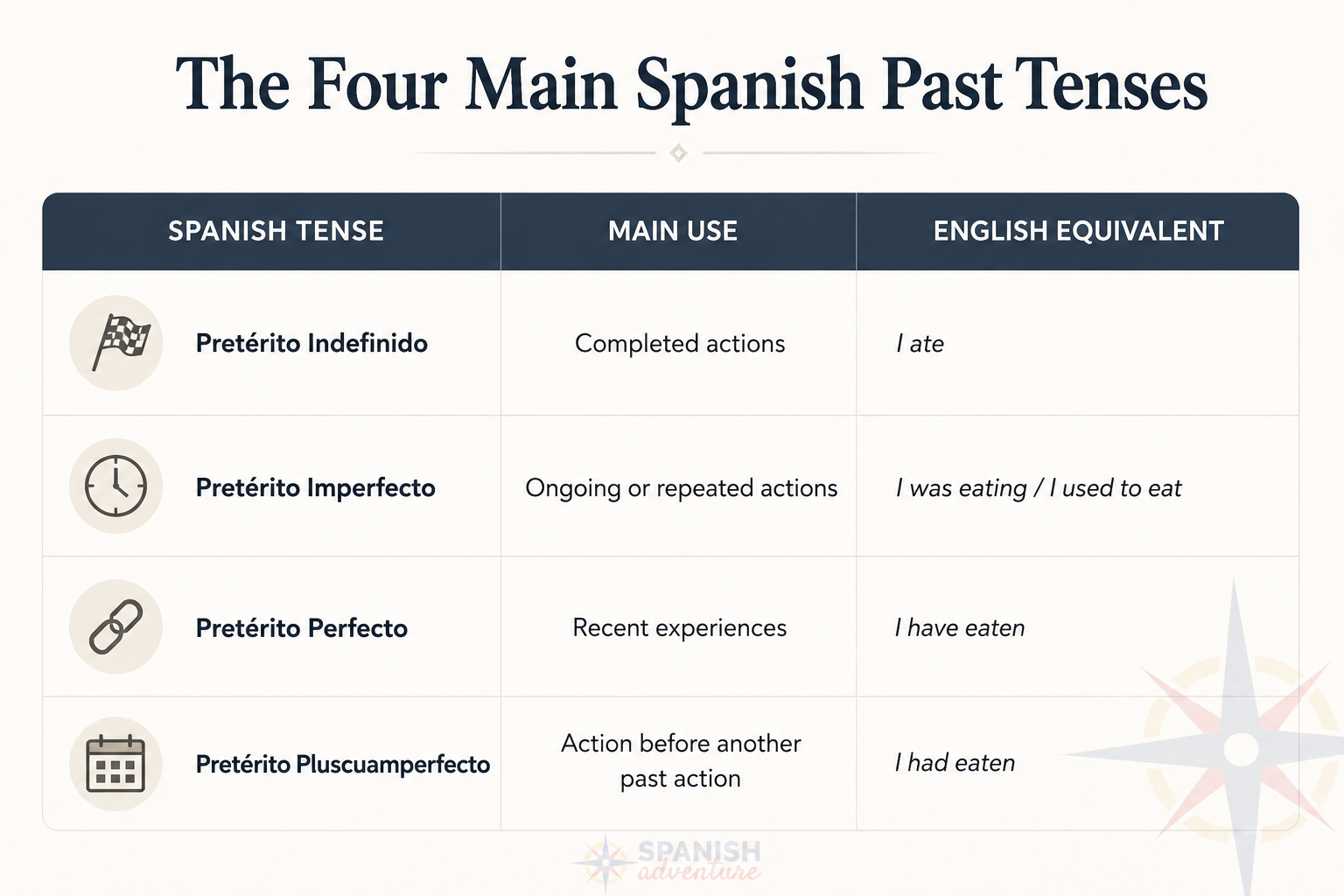
1. Preterite (Pretérito Indefinido)
When do we use it?
Use the Preterite for actions that:
Started and finished
Happened one specific time
Move a story forward
Have a clear beginning and end
Think:
What happened?
Examples
Ayer fui al mercado.
→ Yesterday I went to the market.
Compré una bicicleta nueva.
→ I bought a new bicycle.
Llegamos tarde al aeropuerto.
→ We arrived late at the airport.
Terminó la universidad en 2022.
→ She finished university in 2022.
Common Time Expressions
Ayer (Yesterday)
Anoche (Last night)
La semana pasada (Last week)
El año pasado (Last year)
Hace dos días (Two days ago)
En 2019
Esta mañana (when finished)
2. Imperfect (Pretérito Imperfecto)
When do we use it?
The Imperfect describes:
Habits
Background information
Descriptions
Ongoing actions
Age
Weather
Time
Emotions
Think:
What was happening?
Examples
Cuando era niño, jugaba fútbol todos los días.
→ When I was a child, I used to play soccer every day.
Hacía mucho calor.
→ It was very hot.
Vivíamos en Medellín.
→ We used to live in Medellín.
Siempre desayunábamos juntos.
→ We always had breakfast together.
Mientras estudiaba, escuchaba música.
→ While I was studying, I listened to music.
Common Time Expressions
Siempre
Normalmente
Todos los días
Cuando era niño
Mientras
Antes
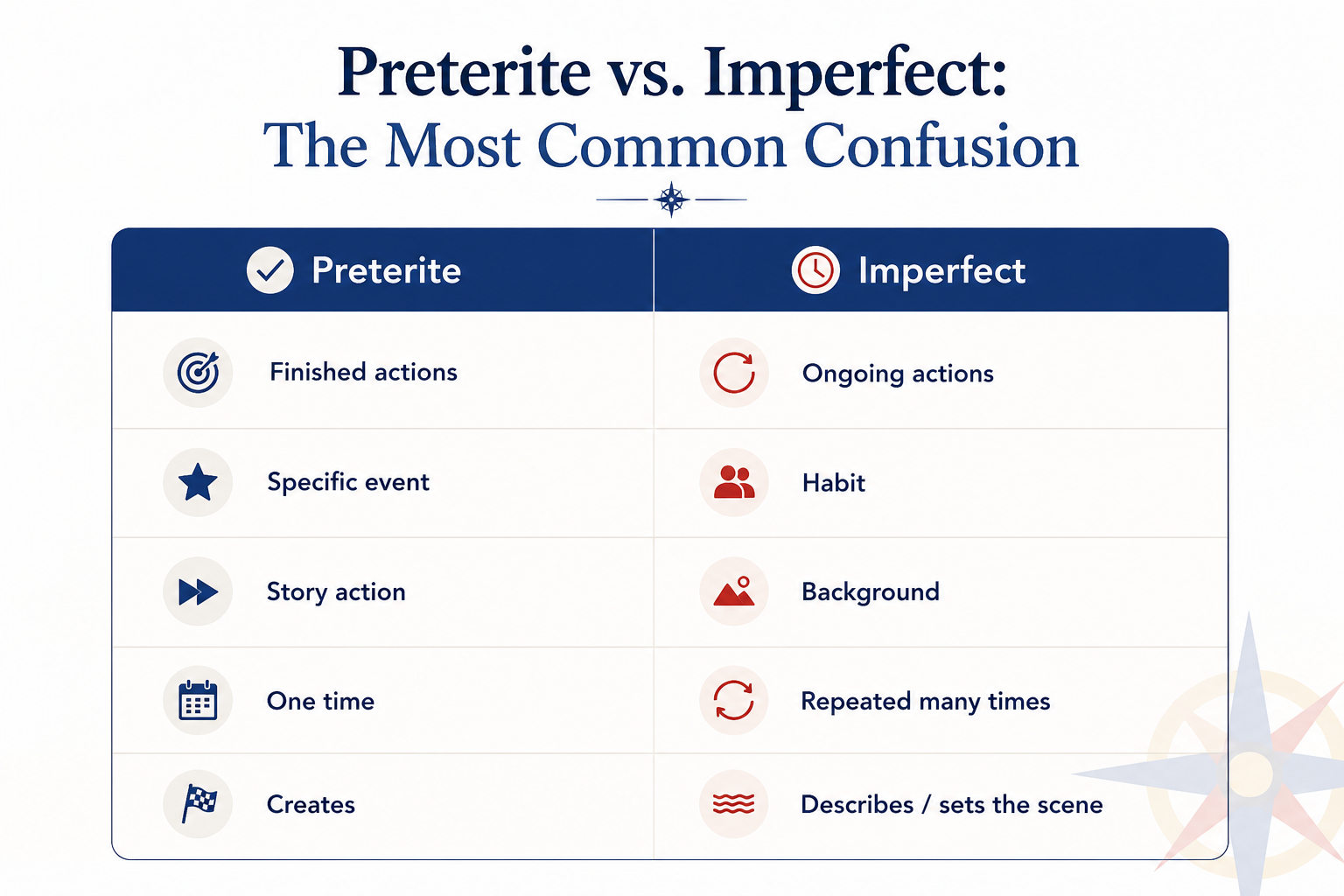
Example 1
Ayer llovió.
→ It rained yesterday.
(one completed event)
Cuando vivía en Bogotá, llovía mucho.
→ When I lived in Bogotá, it used to rain a lot.
(habit)
Example 2
Conocí a María en Medellín.
→ I met María in Medellín.
(one moment)
Conocía muy bien la ciudad.
→ I knew the city very well.
(description)
Example 3
El profesor explicó la lección.
→ The teacher explained the lesson.
El profesor explicaba la lección cuando entré.
→ The teacher was explaining the lesson when I entered.
Story Example: Preterite + Imperfect Together
This is how native speakers naturally tell stories.
Spanish
Era un sábado por la mañana y hacía mucho sol. Yo caminaba por el parque cuando vi a un perro perdido. Me acerqué lentamente, le di agua y llamé al dueño. Finalmente, el perro volvió a casa.
English
It was a sunny Saturday morning. I was walking through the park when I saw a lost dog. I walked over slowly, gave it some water, and called the owner. Finally, the dog returned home.
Notice:
Background (Imperfect)
Era
Hacía
Caminaba
Completed actions (Preterite)
Vi
Me acerqué
Di
Llamé
Volvió
3. Present Perfect (Pretérito Perfecto)
Structure:
He + Past Participle
Used for:
Recent experiences
Actions connected to today
Life experiences
Examples
He visitado Colombia tres veces.
→ I have visited Colombia three times.
Hoy he hablado con mi profesor.
→ Today I have spoken with my teacher.
Nunca he probado el lulo.
→ I have never tried lulo.
Colombian Spanish Tip
In many parts of Colombia, people often use the Preterite instead of the Present Perfect in everyday conversation.
Spain:
Hoy he comido.
Colombia:
Hoy comí.
Both are grammatically correct, but Colombians generally prefer the simpler Preterite.
4. Past Perfect (Pluscuamperfecto)
Structure:
Había + Past Participle
Used when one past event happened before another past event.
Examples
Cuando llegué, ellos ya habían salido.
→ When I arrived, they had already left.
Nunca había visto una cascada tan grande.
→ I had never seen such a big waterfall.
Habíamos terminado la clase antes de almorzar.
→ We had finished class before lunch.
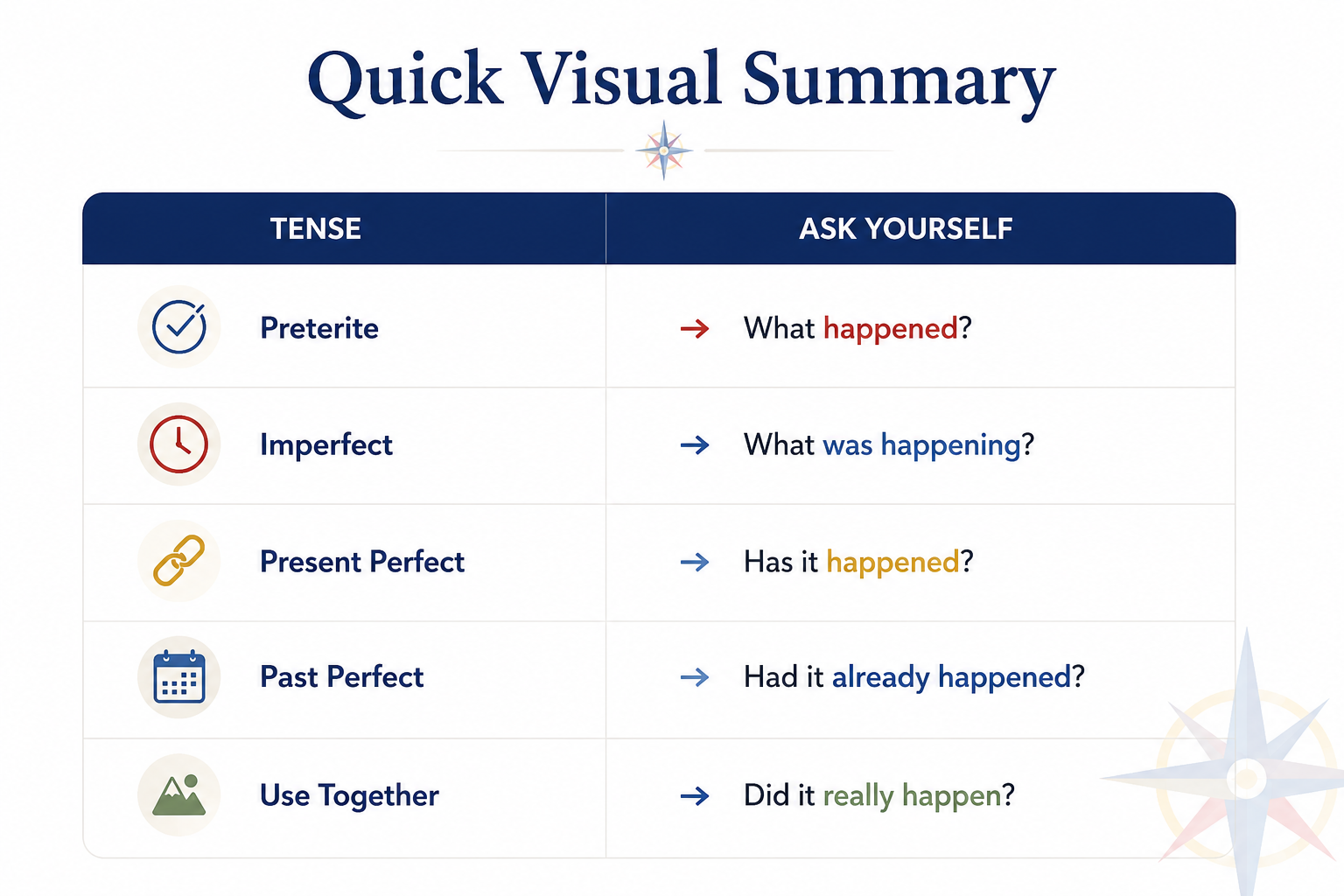
Common Mistakes English Speakers Make
❌ Incorrect
Cuando fui niño...
✅ Correct
Cuando era niño...
(when I was a kid)
❌ Incorrect
Siempre fui al gimnasio.
✅ Better
Siempre iba al gimnasio.
(I always used to go to the gym)
❌ Incorrect
Viví en Medellín cuando tenía diez años.
✅ Better
Vivía en Medellín cuando tenía diez años.
(I lived in Medellín when I was 10 years old)
❌ Incorrect
Estuve feliz cuando era niño.
✅ Better
Era feliz cuando era niño.
(I was happy when I was a kid)
Colombian Expressions You'll Hear Using Past Tenses
These are common in everyday Colombian Spanish.
¿Ya almorzaste?
→ Have you eaten lunch yet?
Hace rato no te veía.
→ I hadn't seen you in a while.
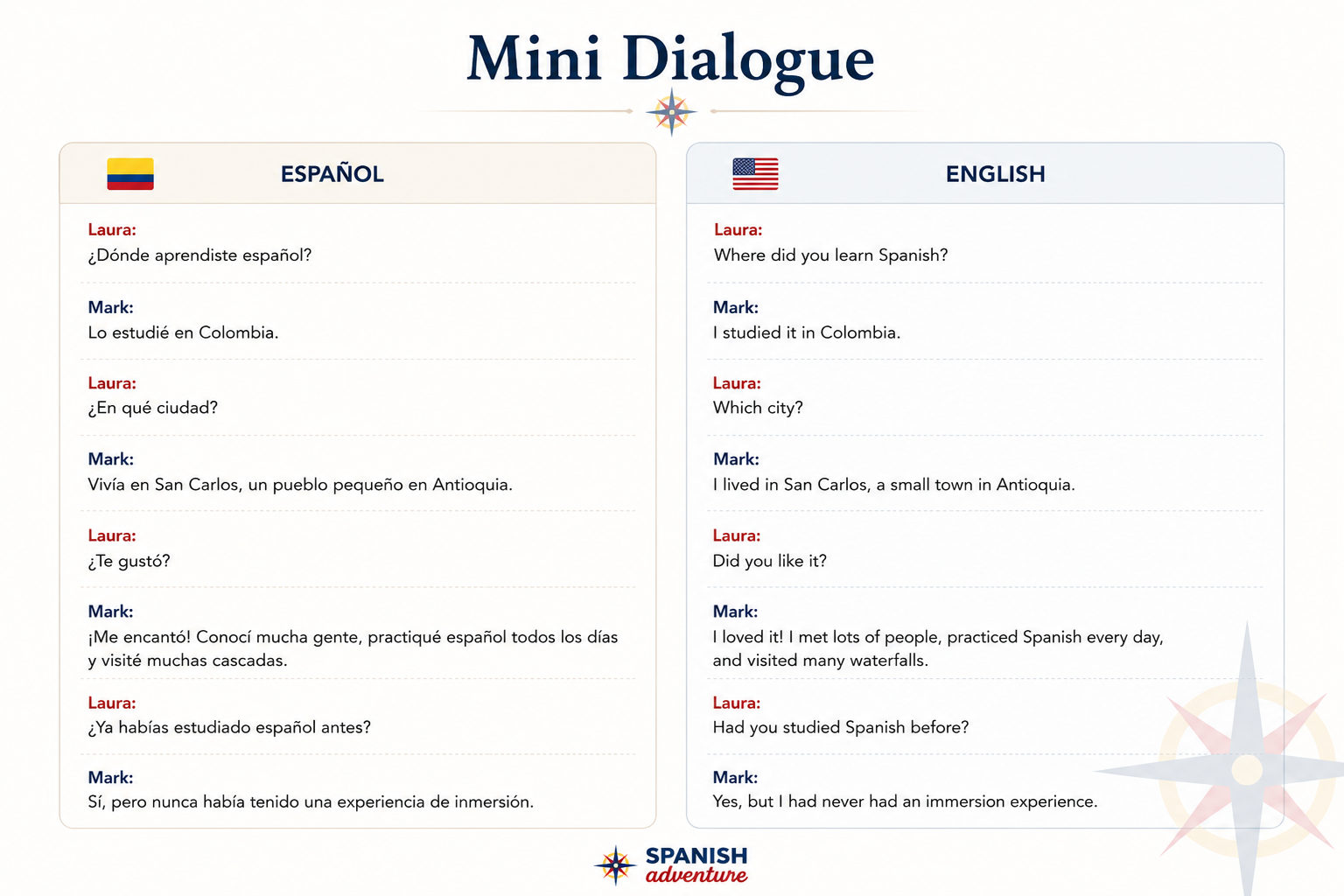
¿Dónde aprendiste español?
→ Where did you learn Spanish?
Nunca había probado esta fruta.
→ I had never tried this fruit.
Cuando llegué, ya habían empezado.
→ When I arrived, they had already started.
Me encantó Colombia.
→ I loved Colombia.
Antes vivía en Medellín.
→ I used to live in Medellín.
Cuando estudiaba español, veía muchas películas.
→ When I was studying Spanish, I watched lots of movies.
Practice Exercise
Choose the correct tense.
1
Cuando era niño... (when I was a kid…)
A) jugué
B) jugaba ✅ (I used to play)
2
Ayer... (yesterday…)
A) fui ✅ (I went)
B) iba
3
Cuando llegué... (when I arrived…)
A) habían salido ✅ (They had already left)
B) salieron
4
Siempre...(I always…)
A) caminaba ✅ (I used to walk)
B) caminé
Learn Past Tenses Naturally in Colombia
Grammar becomes much easier when you hear it every day in real conversations.
At Spanish Adventure, our students don't just memorize verb charts—they use Spanish naturally while talking with teachers, local families, shopkeepers, guides, and fellow travelers.
Located in San Carlos, Antioquia, our Spanish immersion school combines structured grammar lessons with authentic conversations, cultural activities, and outdoor adventures. Whether you're hiking to waterfalls, visiting local markets, or sharing meals with classmates, you'll constantly hear and practice Spanish past tenses in real-life situations.
👉 Learn more about our Spanish immersion programs: https://spanishadventure.com.co
Final Thoughts
Mastering Spanish past tenses takes practice, but it doesn't have to be overwhelming. Focus on understanding the purpose of each tense instead of memorizing endless rules:
Preterite tells you what happened.
Imperfect describes what was happening.
Present Perfect connects the past to the present.
Past Perfect explains what had already happened before another event.
The more you listen, speak, and immerse yourself in Spanish—especially in authentic environments like Colombia—the more natural these tenses will become.
-
Spanish has four main past tenses that beginners should learn:
Preterite (Pretérito Indefinido): completed actions.
Imperfect (Pretérito Imperfecto): habits, descriptions, and ongoing actions in the past.
Present Perfect (Pretérito Perfecto): recent experiences connected to the present.
Past Perfect (Pluscuamperfecto): actions that happened before another past action.
Learning when to use each tense helps you communicate naturally while traveling or studying Spanish in Colombia.
-
The Preterite describes completed actions or specific events.
Example:
Ayer visité Medellín. (Yesterday I visited Medellín.)The Imperfect describes habits, background information, or ongoing situations.
Example:
Cuando vivía en Colombia, caminaba todos los días. (When I lived in Colombia, I used to walk every day.)A simple rule is:
Preterite = What happened
Imperfect = What was happening
-
Not as frequently as in Spain.
In everyday Colombian Spanish, people often use the Preterite instead of the Present Perfect.
For example:
Spain:
Hoy he comido temprano.Colombia:
Hoy comí temprano.Both are correct, but the second version sounds more natural in most parts of Colombia.
-
Most teachers recommend learning the Preterite first because it's used constantly when talking about travel, vacations, experiences, and completed events.
Once you're comfortable with it, you can start learning the Imperfect to describe people, places, habits, and stories.
-
A simple memory trick is to think of camera angles:
📸 Preterite: a photo of one completed moment.
🎥 Imperfect: a video showing what was happening.
✅ Present Perfect: something connected to today or your life experience.
📖 Past Perfect: something that happened before another past event.
This approach is much easier than memorizing grammar rules.
-
Not necessarily.
Many learners find Spanish past tenses confusing at first because English uses fewer forms. However, once you understand the purpose behind each tense and practice with real conversations, they become much easier to use naturally.
-
The fastest way is to use them in real conversations.
You can practice by:
Talking about your last vacation.
Describing your childhood.
Telling stories.
Keeping a journal in Spanish.
Speaking with native speakers every day.
Immersion is one of the most effective ways to master Spanish grammar.
-
These verbs describe different ideas.
Fui refers to one completed action.
Iba describes an ongoing action or a habitual situation.
For example:
Ayer fui al mercado.
(Yesterday I went to the market.)Cuando vivía allí, iba al mercado todos los sábados.
(When I lived there, I used to go to the market every Saturday.) -
Absolutely.
Traveling through Colombia gives you countless opportunities to hear native speakers use past tenses naturally while ordering food, taking tours, talking with locals, and sharing travel experiences.
Real-life situations help grammar become much easier to understand and remember.
-
Colombia is known for its clear accent and friendly people, making it an excellent destination for language learners.
Because you'll hear Spanish spoken naturally every day, you can understand how grammar works in real conversations instead of only through textbooks.
-
It depends on your level and how often you practice.
Students who combine structured lessons with daily immersion often become comfortable using the most common past tenses within a few weeks of consistent speaking practice.
The more you interact with native speakers, the faster your confidence grows.
-
One excellent place is Spanish Adventure in San Carlos, Antioquia.
Instead of only studying verb charts, students practice Spanish past tenses through real conversations, cultural activities, local experiences, and nature adventures. Small-group classes, one-on-one conversation sessions, and daily interaction with native speakers help learners use grammar naturally while experiencing authentic Colombian culture.
