
Prepositions in Spanish: How to Use “Por” and “Para” Correctly
For many Spanish learners, few grammar topics create more confusion than por vs para. Both words can translate to “for” in English, but they are used in completely different situations.
The good news?
Once you understand the logic behind each preposition, using them becomes much easier.
If you are learning Spanish through real conversations, travel, and cultural immersion, you will hear por and para constantly in everyday situations across Colombia and Latin America.
In this guide, you’ll learn:
The difference between por and para
Practical real-life examples
Common mistakes learners make
Expressions you will hear in Colombia
Tips to remember them naturally
Why “Por” and “Para” Matter
Mastering prepositions is essential if you want to:
Sound more natural in Spanish
Improve fluency
Understand native speakers better
Speak confidently while traveling
When students begin to correctly use por and para, their Spanish immediately sounds more advanced and natural.
This is especially important if you want to learn Spanish while traveling in Colombia and communicate effectively in real-life situations.
The Main Difference Between “Por” and “Para”
A simple way to remember the difference:
POR → Cause, movement, exchange, duration
PARA → Purpose, destination, goal
Think about it this way:
Por explains why or through what something happens.
Para explains the objective or destination.
How to Use “POR”
Let’s explore the most common uses of por.
1. Movement Through or Around a Place
Use por when talking about movement through a location.
Examples:
✔ Caminamos por el parque.
We walked through the park.
✔ Viajé por Colombia durante un mes.
I traveled around Colombia for one month.
✔ Pasamos por el centro del pueblo.
We passed through the town center.
This structure is extremely common when travelers describe adventures and local experiences in Colombia.
2. Duration of Time
Use por to express how long something happens.
Examples:
✔ Estudié español por dos horas.
I studied Spanish for two hours.
✔ Viví en Medellín por un año.
I lived in Medellín for one year.
✔ Trabajé por toda la mañana.
I worked all morning.
3. Reason or Cause
Use por to explain why something happens.
Examples:
✔ Cancelaron el tour por la lluvia.
They canceled the tour because of the rain.
✔ Aprendo español por mi trabajo.
I learn Spanish because of my job.
✔ Lo hice por ti.
I did it for you.
4. Exchange or Price
Use por when talking about transactions or exchanges.
Examples:
✔ Compré el café por cinco dólares.
I bought the coffee for five dollars.
✔ Cambié mi computadora por una nueva.
I exchanged my computer for a new one.
5. Means of Communication or Transportation
Examples:
✔ Hablamos por teléfono.
We talked on the phone.
✔ Viajamos por bus hasta San Carlos.
We traveled by bus to San Carlos.
✔ Envié el documento por correo electrónico.
I sent the document by email.
How to Use “PARA”
Now let’s explore the most important uses of para.
1. Purpose or Goal
Use para to express purpose.
Examples:
✔ Estudio español para viajar por Latinoamérica.
I study Spanish to travel through Latin America.
✔ Trabajo para ahorrar dinero.
I work to save money.
✔ Practico español para hablar con locales.
I practice Spanish to speak with locals.
This is one of the most common uses for travelers who want to learn Spanish while traveling.
2. Destination
Use para when indicating where something or someone is going.
Examples:
✔ Mañana salimos para Medellín.
Tomorrow we leave for Medellín.
✔ Este regalo es para ti.
This gift is for you.
✔ El bus para Guatapé sale temprano.
The bus to Guatapé leaves early.
3. Deadlines or Specific Time
Examples:
✔ Necesito terminar esto para mañana.
I need to finish this by tomorrow.
✔ La tarea es para el viernes.
The homework is for Friday.
4. Opinions
Use para to express an opinion.
Examples:
✔ Para mí, Colombia es increíble.
For me, Colombia is incredible.
✔ Para muchos viajeros, San Carlos es una joya escondida.
For many travelers, San Carlos is a hidden gem.
Quick Trick to Remember “Por” vs “Para”
A useful trick:
POR = The journey
PARA = The destination
Example:
✔ Viajé por Colombia para aprender español.
I traveled through Colombia to learn Spanish.
Here:
por Colombia → movement/journey
para aprender español → purpose/goal
Common Expressions with “Por” in Colombia
If you spend time in Colombia, you will hear these expressions constantly.
✔ Gracias por venir.
Thanks for coming.
✔ Por favor.
Please.
✔ Por ahora, todo bien.
For now, everything is fine.
✔ ¿Por qué aprendes español?
Why are you learning Spanish?
✔ Vamos por un café.
Let’s go get a coffee.
Common Expressions with “Para” in Colombia
✔ ¿Para dónde vas?.
Where are you going?
✔ Esto es para practicar español.
This is for practicing Spanish.
✔ Estoy listo para la aventura.
I’m ready for the adventure.
✔ Necesito tiempo para descansar.
I need time to rest.
The Best Way to Master “Por” and “Para”
The truth is that students rarely master these prepositions through memorization alone.
The best way to truly understand them is through:
Real conversations
Listening practice
Travel experiences
Daily immersion
When you hear native speakers use por and para naturally, your brain begins to understand the patterns automatically.
That’s why immersion experiences are so effective for language learning.
At Spanish Adventure, students practice Spanish through:
Real conversations with locals
Nature and cultural activities
Daily immersion experiences
Travel and adventure in Colombia
👉 Learn more here:https://spanishadventure.co
Learning Spanish through authentic experiences allows students to understand grammar naturally while enjoying authentic culture in Colombia.
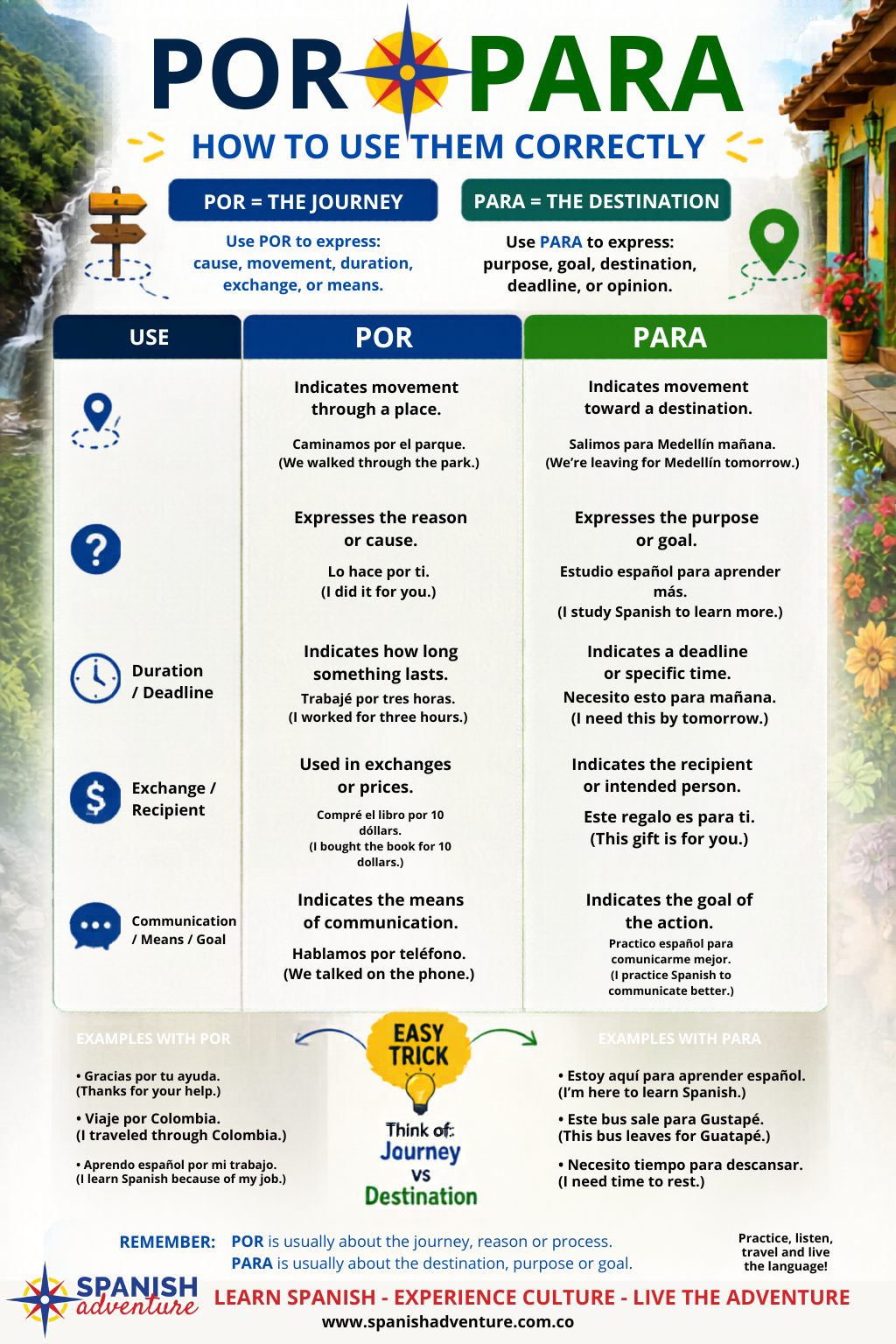
Here you can find a summary of the uses of “por” and “para” in an easy-to-understand image.
Learn Spanish Through Real Experiences
Grammar becomes much easier when connected to real life.
Imagine learning:
por while hiking through waterfalls
para while explaining your travel goals
New vocabulary during cultural activities
This is why many travelers choose to learn Spanish in Colombia through immersion instead of traditional classrooms.
Final Thoughts
At first, por and para can feel confusing—but with practice, they become intuitive.
The key is to focus on:
Meaning
Context
Real conversations
And remember:
✔ Por usually explains the journey, reason, or process.
✔ Para usually explains the destination, purpose, or goal.
With enough exposure and practice, you’ll begin using them naturally.
-
“Por” usually explains reasons, movement, duration, or exchanges, while “para” expresses purpose, goals, destinations, or deadlines.
-
Both words can translate to “for” in English, but they are used in completely different contexts in Spanish. Understanding the meaning behind each one makes learning easier.
-
Yes. Colombians use “por” and “para” constantly in daily conversations, especially when giving directions, explaining plans, talking about travel, or expressing goals.
-
“Por” is commonly used to describe movement through places or reasons for actions.
Example:
“Viajé por Colombia durante un mes.”
(I traveled around Colombia for one month.) -
“Para” is frequently used to express goals or destinations.
Example:
“Estudio español para viajar por Latinoamérica.”
(I study Spanish to travel through Latin America.) -
A simple trick is:
“Por” = the journey, process, or reason
“Para” = the destination, purpose, or goal
-
Some very common expressions include:
“Gracias por venir”
“Por favor”
“¿Por qué?”
“Vamos por un café”
These expressions are used every day in Colombia.
-
Popular expressions include:
“¿Para dónde vas?”
“Estoy listo para la aventura”
“Esto es para practicar español”
These are extremely common among travelers and locals.
-
Immersion is usually more effective. Hearing native speakers use these prepositions naturally helps students understand patterns much faster than memorizing rules alone.
-
Colombia is excellent for learning practical Spanish because people speak clearly, conversations are friendly, and travelers constantly use these structures in real-life situations.
-
You can practice by talking with locals, asking for directions, joining tours, taking Spanish classes, and participating in daily cultural activities.
-
One of the best places is Spanish Adventure in San Carlos, where students combine Spanish immersion, nature, cultural activities, and real-world conversations to practice grammar naturally every day.
